



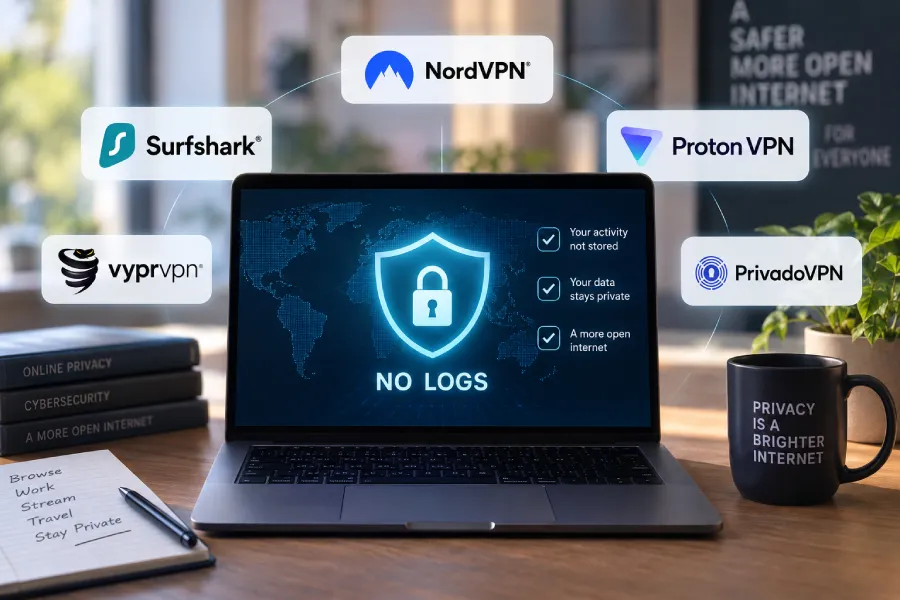
A no-logs policy sounds straightforward. A VPN provider says it does not log your activity, so your browsing should remain private.
The reality is often more complicated.
A provider may avoid recording the websites you visit while still temporarily processing your IP address or connection timestamps. Another may retain account information while keeping that data separate from VPN activity. The underlying server architecture also affects how much usable information could exist if a server were compromised or seized.
That is why I would never choose a VPN based solely on the words "no logs" in their marketing materials.
For this comparison, I evaluated Surfshark, NordVPN, VyprVPN, Proton VPN, and PrivadoVPN. I reviewed each provider's published privacy policies and technical documentation. I also considered independent no-logs assessments and available online customer reviews.
The biggest differences come down to what each VPN actually collects and how those practices have been independently verified. I also considered whether the provider's infrastructure minimizes the amount of data that can be retained in the first place.
Best No-Log VPNs Compared
Surfshark: Best for unlimited device protection
Proton VPN: Best for open-source transparency
VyprVPN: Best for provider-owned infrastructure
PrivadoVPN: Best for no-logs protection on a free plan
NordVPN: Best for long-term audit history
Prices and other service details can change. Figures reflect provider information available at the time of this review.
Surfshark
Best for unlimited device protection
Overall score: 4.9/5
Logging practices: 4.9/5
Independent verification: 4.9/5
Infrastructure and DNS privacy: 4.9/5
Jurisdiction and transparency: 4.8/5
User experience and reputation: 4.7/5
Surfshark stands out for pairing a strong no-logs policy with infrastructure designed to limit how much VPN activity can be retained.
Its privacy policy says the company does not keep records of the websites users visit. Surfshark says it does not retain browsing history or network traffic. Bandwidth usage is not retained either. Connection timestamps and session information are also excluded from its permanent records.
Surfshark does temporarily process some connection data, including a user's IP address and connection timestamps, so the VPN can function. According to the company, that information is automatically deleted within 15 minutes after a session ends.
I see that level of detail as a positive. Every VPN has to process some information to establish and maintain a connection. What matters more is how long that information exists and whether it can later be tied back to what a user did online.
Surfshark's server architecture adds another layer of protection. The company uses RAM-only servers, which means data is stored in volatile memory rather than on a traditional hard drive. Once a server is rebooted, that information is cleared rather than remaining on disk.
Surfshark's no-logs practices have also undergone multiple independent assessments by Deloitte.
The company's privacy claims have also been tested outside the audit process. Surfshark reported receiving a legally binding warrant from an Amsterdam court in April 2026. It said it could confirm that an account existed and provide payment-related information. It did not, however, have the user's online activity to turn over.
That example gets to the heart of what "no logs" should mean. A VPN provider may still know that you are a customer. It may also retain account or billing information. What it should not be able to do is reconstruct your browsing activity from stored VPN logs.
Surfshark is based in the Netherlands, but I would not judge the service on jurisdiction alone. More important is whether the company limits how long connection data exists. Its RAM-only infrastructure reduces what can persist on a server. The repeated independent assessments add another layer of confidence, as does its published record of responding to legal requests without producing browsing activity.
Online reviews generally highlight Surfshark's speed and ease of use, although some users report occasional connection problems.
Pros
Independently assessed no-logs practices
RAM-only VPN infrastructure
Detailed disclosure of temporary connection processing
Public transparency reporting
Unlimited simultaneous connections
Cons
Dedicated IP costs extra
Some additional privacy tools require higher-tier plans
Pricing: Surfshark Starter currently begins at $2.49 per month with its 24-month plan. The plan includes unlimited simultaneous connections, so the price does not increase with the number of supported devices you want to protect.
Pro tip: Look beyond the no logs label when comparing VPNs. Surfshark specifies that certain connection data is temporarily processed and automatically deleted within 15 minutes after a session ends, giving you a clearer picture of what happens to your data.
Final verdict: Surfshark is my top no-logs VPN in this comparison. Its RAM-only infrastructure limits what can persist on its servers, while repeated Deloitte assessments provide independent verification of its logging practices. Unlimited device connections add to its value for users who want the same privacy protections across multiple devices.
Proton VPN
Best for open-source transparency
Overall score: 4.8/5
Logging practices: 5.0/5
Independent verification: 5.0/5
Infrastructure and DNS privacy: 4.8/5
Jurisdiction and transparency: 5.0/5
User experience and reputation: 4.3/5
Proton VPN stands out for the level of transparency it provides around its privacy practices.
Its privacy documentation is unusually direct. Proton says it does not log browsing activity or traffic content. It also says it does not log IP addresses or session lengths. Location-based information is excluded as well.
Proton operates from Switzerland. Its VPN applications are open source, which provides another layer of visibility beyond the privacy policy itself.
Independent verification is another strength. Proton announced in June 2026 that it had passed its fifth consecutive annual independent no-logs audit. Securitum examined the infrastructure behind Proton's no-logs implementation rather than merely reviewing the language of the privacy policy. Proton also makes its audit reports publicly accessible.
Its infrastructure takes a somewhat different approach from Surfshark's RAM-only model. Proton says its VPN servers use full-disk encryption and contain no VPN session logs or user data. The company physically owns and operates its Secure Core servers.
Secure Core can route a connection through hardened infrastructure in jurisdictions such as Switzerland before sending it to the final VPN server. That architecture can provide additional protection for users concerned about the infrastructure hosting the final VPN server.
Online reviews are generally positive about Proton VPN's security and transparency, although some users report slower connections in certain situations.
Pros
Consecutive annual no-logs audits
Very specific no-logs policy
Swiss jurisdiction
Open-source VPN applications
Secure Core infrastructure
Cons
Limited to 10 simultaneous connections on paid plans
Secure Core requires a paid subscription
Pricing: Proton VPN offers a free plan, while Proton VPN Plus currently starts at $3.49 per month with its two-year subscription. The paid plan adds features such as Secure Core and supports up to 10 simultaneous device connections.
Pro tip: Proton VPN is worth considering if you want more visibility into the service you are trusting with your traffic. Its apps are open source. Proton also publishes its independent no-logs audit reports, allowing you to examine the findings rather than relying solely on the company's privacy claims.
Final verdict: Proton VPN combines open-source applications with a strong record of independent verification, including five consecutive annual no-logs audits.
VyprVPN
Best for provider-owned infrastructure
Overall score: 4.2/5
Logging practices: 4.7/5
Independent verification: 3.8/5
Infrastructure and DNS privacy: 4.8/5
Jurisdiction and transparency: 3.8/5
User experience and reputation: 3.9/5
VyprVPN stands out for the level of control it maintains over the infrastructure that supports its VPN service.
The provider says it owns and operates its server and network infrastructure rather than relying on third-party hosting companies. It also operates VyprDNS.
VyprVPN says its servers do not retain user connection information. Application logs can exist locally on a user's device, but VyprVPN says they are sent to the company only when the user chooses to submit them for troubleshooting.
Locally stored diagnostic information differs from a provider's centralized VPN activity logs.
VyprVPN's no-logs practices have also undergone independent verification. Leviathan Security assessed its implementation in 2018 after VyprVPN moved away from an earlier policy that retained some connection metadata.
The main consideration is how much weight to give that assessment today. A privacy audit reflects the service at the time of the audit, and VyprVPN has undergone changes since then.
Its parent company is now Certida LLC, which is based in Texas. As a result, VyprVPN's current jurisdiction differs from that when its no-logs practices were independently assessed.
Operating under US jurisdiction does not automatically make a VPN less secure or private. If usable activity data is not retained, there is less information available to disclose. Jurisdiction can still matter, however, for users who consider legal privacy protections when choosing a VPN.
Pros
Self-controlled server and network infrastructure
Own DNS service
Strong stated no-logs policy
Local diagnostic logs require user action before submission
Cons
No recent recurring independent no-logs assessment identified
No dedicated IP option
Smaller server-location footprint than some competitors
Pricing: VyprVPN currently starts at $5 per month. Unlike providers that divide their VPN service across several paid tiers, VyprVPN offers its core VPN capabilities under a simpler subscription structure.
Pro tip: Look at how recently a VPN's no-logs practices have been independently verified. VyprVPN underwent an independent assessment in 2018, and an updated review would provide additional assurance that its current practices continue to align with its stated no-logs policy.
Final verdict: VyprVPN stands out for controlling its own server and network infrastructure, which reduces its reliance on third-party hosting providers. Combined with its no-logs policy, that level of control gives it a strong privacy foundation.
PrivadoVPN
Best for no-logs protection on a free plan
Overall score: 4.3/5
Logging practices: 4.7/5
Independent verification: 3.6/5
Infrastructure and DNS privacy: 4.4/5
Jurisdiction and transparency: 4.1/5
User experience and reputation: 4.4/5
PrivadoVPN says it does not log browsing history or traffic destinations. It also says it does not retain data content or users' IP addresses. DNS queries are excluded as well. PrivadoVPN says it cannot associate activity from one of its VPN server IP addresses with a particular user.
DNS traffic is routed through PrivadoVPN's private DNS servers rather than being sent to the user's ISP.
One area where I would like to see additional verification is an independent audit of its no-logs practices. I could not find evidence that PrivadoVPN's no-logs claims have been independently assessed. An external review would provide additional assurance that its technical practices align with its published policy.
Online reviews generally praise PrivadoVPN for its simple setup and ability to protect multiple devices.
Pros
Does not claim to retain browsing history or IP addresses
Private DNS handling
Free plan available
Simple multi-device support
Cons
No comparable recurring independent no-logs audit identified
Limited to 10 simultaneous connections
Free plan includes 10GB of full-speed data every 30 days, after which speeds are limited.
Manual VPN configurations require Premium
Pricing: PrivadoVPN offers a free plan, while its paid Unlimited VPN plan currently starts at $1.11 per month with its 24-month subscription. The paid plan provides unlimited data and access to PrivadoVPN's full server network.
Pro tip: PrivadoVPN is worth considering if you want to try a no-logs VPN before paying for a subscription. Its free plan lets you test the service first, but I would still weigh the lack of recent independent no-logs verification against the stronger audit histories of some competitors.
Final verdict: PrivadoVPN offers a detailed no-logs policy and private DNS handling at a competitive price. Its combination of privacy protections and an accessible free plan makes it a compelling option for users looking for an affordable VPN.
NordVPN
Best for long-term audit history
Overall score: 4.8/5
Logging practices: 4.9/5
Independent verification: 5.0/5
Infrastructure and DNS privacy: 4.9/5
Jurisdiction and transparency: 4.9/5
User experience and reputation: 4.5/5
NordVPN has built a substantial record of independent verification around its no-logs policy.
The company has undergone six independent assessments of its no-logs practices. PricewaterhouseCoopers conducted the first two reviews, while Deloitte performed the later assessments. The most recent examination took place in 2025.
I see the repeated assessments as a strength because VPN services change over time. Applications are updated, and server infrastructure evolves. A recurring audit program provides more current evidence that the provider continues to follow its stated logging practices.
NordVPN says it does not retain browsing history or DNS queries that could identify user activity. The company operates from Panama, where it says VPN providers are not subject to requirements that would force them to retain VPN activity.
NordVPN also operates its VPN servers using RAM-only infrastructure. Instead of storing data on traditional hard drives, the servers rely on volatile memory that is cleared when the server is restarted.
I give NordVPN high marks here because its no-logs practices have been independently assessed multiple times, while its RAM-only servers further limit what can persist on its infrastructure.
Pros
Six independent no-logs assessments
RAM-only VPN servers
Panama jurisdiction
Mature privacy and security program
Cons
Limited to 10 simultaneous connections
Dedicated IP costs extra
Pricing: NordVPN Basic currently starts at $3.49 per month with its two-year subscription. Higher-tier plans add security and privacy tools beyond the core VPN service, but the Basic plan includes NordVPN's no-logs protections and access to its VPN network.
Pro tip: NordVPN's audit history is worth considering if independent verification is a priority. Its repeated assessments show an ongoing commitment to having its no-logs practices independently reviewed.
Final verdict: NordVPN's RAM-only server infrastructure limits what can persist on its VPN servers, while its Panama jurisdiction adds to its privacy appeal. Its established no-logs practices make it a strong option for users focused on minimizing retained VPN activity.
What does 'no logs' actually mean?
The phrase "no logs" has become so common in VPN marketing that it can mean different things depending on the provider.
A VPN may not maintain activity logs, meaning it does not record the websites you visit or the content passing through its servers. That does not necessarily mean the provider retains no information at all.
Connection logs are different. They can show when a user connected to the VPN or which server was used. A provider that retains a user's source IP address may also have information identifying where the connection originated.
Timestamps can become more sensitive when combined with IP information. Knowing that a particular IP address connected at a specific time could potentially allow that record to be correlated with activity observed elsewhere.
Bandwidth records reveal how much data passed through a connection. That information is less revealing than browsing history alone, but retaining it can still yield additional information about a VPN session.
Account information is another consideration. A VPN may need an email address to maintain your account, while a payment processor may retain billing information. Having that information does not automatically undermine a no-logs policy because account records are different from your VPN activity records.
A provider may know that you are a customer without knowing what you did while connected to the VPN. For me, the real test of a no-logs policy is whether the information it retains could be used to reconstruct that activity.
Why independent no-logs audits matter
A privacy policy tells you what a VPN provider says it does with your data. An independent assessment provides outside verification that its actual practices align with those claims.
I give more weight to providers that undergo these assessments regularly. VPN services change over time, so an audit conducted several years ago may not reflect how the service operates today. Repeated assessments provide more current evidence that the provider continues to follow its stated no-logs practices.
Even then, an audit is not an absolute guarantee. It examines a specific part of the service during a particular period. I view independent verification as strong supporting evidence rather than permanent proof that a VPN will always operate the same way.
Why jurisdiction and server infrastructure matter
Jurisdiction is worth considering when evaluating a VPN, but I would not base a privacy decision on it alone.
A provider in a privacy-friendly country can still retain connection data, which poses privacy risks. On the other hand, a provider can limit its exposure by designing its infrastructure so that sensitive VPN activity is not persistently stored.
Server architecture is therefore just as important to consider. RAM-only servers can reduce the amount of data that persists because information stored in volatile memory is cleared rather than remaining on conventional storage.
DNS handling matters as well. A VPN can encrypt traffic leaving your device, but it still poses a privacy risk if DNS requests escape the tunnel. Privacy can also be affected if those requests are sent to a third party that retains them.
I would look at jurisdiction as one part of the larger privacy picture. More important is how much information the VPN retains and whether its infrastructure is designed to minimize what could be exposed.
How I evaluated these no-logs VPNs
For this comparison, I focused on how well each provider can support its no-logs claims rather than simply taking those claims at face value.
Logging practices (30%): I examined whether providers retain browsing activity or traffic information. I also looked at how they handle IP addresses and connection metadata. Policies that clearly explain temporary processing received more credit than vague claims of collecting "nothing."
Independent verification (25%): I looked at whether each provider's no-logs practices have undergone external assessment. Recent verification received more credit than a single historical audit. Providers that repeat those assessments also scored higher.
Infrastructure and DNS privacy (20%): I evaluated the technical architecture supporting each provider's privacy policy. RAM-only servers received consideration here. I also looked at encrypted server infrastructure and how providers handle DNS requests.
Jurisdiction and transparency (15%): I considered where each VPN legally operates and how clearly its privacy documentation identifies the responsible entity. Transparency reports also contributed to this score, as did accessible technical documentation.
User experience and reputation (10%): I reviewed customer feedback for reliability or usability issues that could affect everyday use. I gave less weight to ratings based on too few reviews to provide a meaningful sample.
The final ratings are my editorial assessment based primarily on provider documentation and independent verification. I also considered customer feedback and the strength of each provider's privacy architecture.
What should you check in a VPN privacy policy?
Do not stop when you find the words "no logs."
Start by determining whether the provider records your online activity. Then check whether it retains your source IP address or VPN-assigned IP address.
Look at connection metadata next. The policy should make clear whether timestamps or session information remain after you disconnect.
DNS handling matters too. Check whether DNS requests remain within the VPN's infrastructure and whether they are logged.
Pay particular attention to temporary processing. A provider that explains what information it processes during a connection and when that information is deleted gives you more useful information than one simply claiming to collect "zero data."
Independent verification is also worth checking. I would give more weight to recent assessments and providers that repeat them as their services evolve.
Frequently asked questions
What is the best no-logs VPN?
Surfshark is my best overall no-logs VPN in this comparison. Its no-logs practices have undergone multiple independent assessments, and its RAM-only architecture limits what can persist on its servers. Its privacy policy also provides useful detail about how temporary connection data is handled.
Proton stands out for its transparency and annual independent audits. NordVPN has built a strong record of independent no-logs verification.
Does no logs mean a VPN collects no information?
A VPN may still maintain information needed to establish and manage your account. Payment information may also be handled by the provider or its payment processor.
What matters is whether the VPN retains information that can connect your identity with your online activity.
Are connection logs the same as activity logs?
Activity logs can reveal what you did while using the VPN. Connection logs describe the VPN session itself.
Connection metadata can still create privacy risks when it contains identifying information. Source IP addresses and precise timestamps may allow separate records to be correlated.
Is a RAM-only VPN automatically better?
Not necessarily.
RAM-only architecture can limit how long data persists on VPN servers, which provides a meaningful privacy benefit. However, it does not compensate for an invasive privacy policy or logging elsewhere in the provider's infrastructure.
Server architecture and logging practices need to be evaluated together.
Which no-logs VPN has the strongest audit history?
NordVPN has completed six independent no-logs assessments. Its most recent review was conducted by Deloitte in 2025.
Proton VPN has also built a strong record with five consecutive annual audits through 2026. Surfshark has undergone repeated independent verification as well, with Deloitte assessing its no-logs practices in 2023 and again in 2025.
Can a no-logs VPN give my information to law enforcement?
A VPN must comply with applicable legal obligations governing its operations. However, a no-logs architecture can limit the information the provider can disclose.
Providers may still have account or payment information even when they do not retain records of a user's VPN activity.
Bottom line
"No logs" should be the starting point for evaluating a VPN's privacy, not the end.
I want to know what a provider means by that claim. More importantly, I want evidence that its actual practices support it.
A detailed privacy policy can explain what information is processed and how long it exists. Independent assessments can provide outside verification of those practices. The way a VPN handles data on its servers also affects how much information could be available in the first place.
No single factor proves that a VPN is private. A strong no-logs policy is more convincing when the provider clearly explains its practices and can back those claims with evidence.
Ultimately, I would trust evidence over a label. "No logs" means much more when you can see what the provider does to support the claim.
For a broader comparison beyond logging practices, see our guide to the best VPNs to buy in 2026.















Comments
Be the first, drop a comment!