




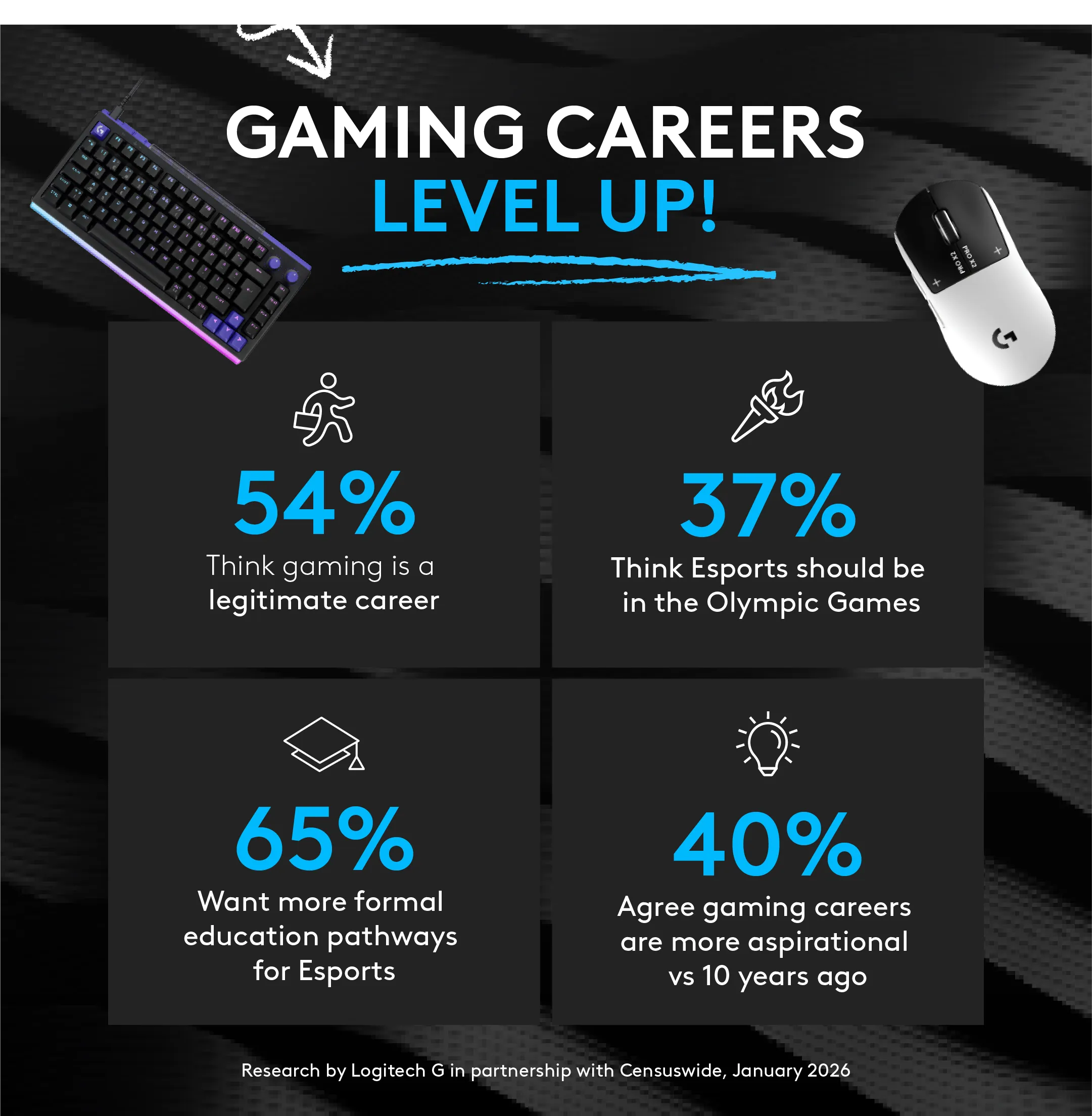
A new global survey commissioned by Logitech G highlights growing recognition of esports and professional gaming as legitimate career options, with 65% of respondents worldwide calling for more formal education pathways for aspiring gaming professionals.
The study, released as part of the Logitech G PRO Series Survey, found that more than half of participants globally (54%) now view professional gaming as a valid career path. However, attitudes toward esports careers differ significantly across generations and regions.
Younger demographics are far more accepting of gaming careers than older generations. Around 67% of Gen Z respondents and 60% of Millennials said they consider professional gaming a legitimate profession, compared to just 37% of Baby Boomers.
Regional differences were also evident. In Germany, only 20% of Baby Boomers recognized professional gaming as a credible career, while in China that figure climbed to 74%.
Derek Perez, Global Communications Gaming Lead at Logitech G, said the findings reflect how esports has evolved beyond entertainment into a professional industry with real career opportunities. He added that stronger support systems and industry investment could help create more opportunities for aspiring esports professionals worldwide.
While esports is becoming more mainstream, traditional professions still rank higher in perceived respectability. Healthcare professionals topped the list globally, followed by lawyers, teachers, and engineers. Professional gaming ranked similarly to careers in entertainment, motorsports, and politics in terms of public perception.
Support for younger people pursuing esports professionally also remains limited. Only 1% of Baby Boomers and 3% of Gen X respondents said they would encourage a child or someone close to them to become a professional gamer. Millennials were also cautious, with only 4% recommending gaming as a career path for younger generations.
Despite that hesitation, many respondents believe esports has become significantly more aspirational over the past decade. Two in five respondents said professional gaming is more desirable in 2026 than it was in 2016.
The survey also identified key challenges facing the esports industry. Financial uncertainty was seen as the biggest barrier to pursuing a gaming career, followed by the highly competitive nature of the industry and a lack of parental or societal support.
Concerns over job security remain widespread, with one-third of respondents believing esports careers lack stability. Additionally, 42% said professional gaming is still often viewed as a hobby rather than a legitimate profession.
At the same time, awareness of the physical and mental demands of esports is growing. A large majority of respondents described professional gaming as mentally demanding, while more than half also viewed it as physically demanding. More than one-third supported the idea of esports being included in the Olympic Games, with support particularly high among Gen Z participants.
Training expectations in esports were also recognized, with many respondents believing professional gamers spend up to 10 to 12 hours per day practicing and developing their skills.
The study further revealed strong global interest in esports education. Nearly half of respondents said schools should include esports classes alongside traditional sports programs. Support for esports education was especially high in countries such as Switzerland and China, while respondents in the UK, France, and Germany were more cautious.
Globally, 65% of participants said universities, colleges, and specialist institutions should offer formal educational pathways for esports and gaming careers. Respondents also pointed to increased mainstream media coverage, better training facilities, greater transparency around earnings, and inclusion in major sporting events as factors that could help professional gaming gain wider acceptance.
Perez said continued investment in training, facilities, and gaming technology will be essential for sustaining growth in esports careers. He also highlighted Logitech G's focus on developing products designed to support both professional competitors and everyday gamers.



Comments
Be the first, drop a comment!